 Book this →
It was 23:40 in a city most foreigners have never heard of, two hours west of the nearest airport with an international arrival hall. I had a confirmed booking, a printed confirmation, and a passport. The woman behind the desk looked at all three, then at her screen, then said the sentence I have now heard in five provinces: 我们这里不接待外国人 — we don't take foreigners here.
23:40,在一个多数外国人没听过的城市,离最近有国际到达的机场两小时车程。我有确认订单、打印件、护照。前台看了三样东西,看了屏幕,然后说出那句话——我在五个省听过同一句:“我们这里不接待外国人”。She was not being hostile. She was being careful, and she was wrong about the law. That distinction matters, because it decides whether you argue, escalate, or simply walk to the next hotel. This is what I have learned since, checked against the actual regulations rather than forum folklore.
她不是恶意,她只是谨慎,而且在法律上错了。这个区别很关键——它决定你该争论、该投诉,还是直接走去下一家店。下面是这几年攒出来的经验,依据是真实法规,不是论坛传说。The rule: a hotel licence is not a nationality filter
In July 2024, seven central departments — Commerce, the Ministry of Public Security, the National Immigration Administration among them — issued a joint notice on making it easier for foreign visitors to stay in Chinese accommodation. The operative line is blunt: local authorities and online booking platforms may not use qualification requirements as a threshold to restrict accommodation operators from receiving foreign guests, and platforms may not publish listings stating that a property does not accept foreign guests.
2024 年 7 月,商务部、公安部、国家移民管理局等七部门联合发文,要求便利境外人员住宿。关键一句很硬:地方相关部门与网络平台不得以资质要求等为门槛,限制住宿业经营者接待境外人员;平台也不得发布“不接待境外人员”的信息。The same position was restated in a public reply from three ministries to a citizen's question in May 2024, in five characters that are worth memorising: 旅馆业不得以无涉外资质为由拒绝接待境外人员 — hotels may not refuse foreign guests on the grounds of lacking foreign-related qualification. The "foreign-related qualification" the desk is invoking has not been a legal bar for years, and Beijing abolished its designated-hotel system for foreigners back in 2003.
2024 年 5 月,三部门答复网民留言时又重申了一遍,那十个字值得背下来:“旅馆业不得以无涉外资质为由拒绝接待境外人员”。前台嘴里的“涉外资质”,早已不是合法门槛;北京 2003 年就取消了外国人定点住宿。So what is legally required is not a licence to host foreigners but a duty to register them. Article 39 of the Exit and Entry Administration Law says the hotel must handle the accommodation registration for the foreign guest and report it to the local public security organ. Article 6 of the hotel security regulations puts a clock on it: the registration goes to the police within 24 hours of check-in.
所以法律要求的不是“接待外国人的资质”,而是登记义务。《出境入境管理法》第 39 条:旅馆须为外国人办理住宿登记并向当地公安机关报送。《旅馆业治安管理办法》第 6 条给了时限:入住 24 小时内报送。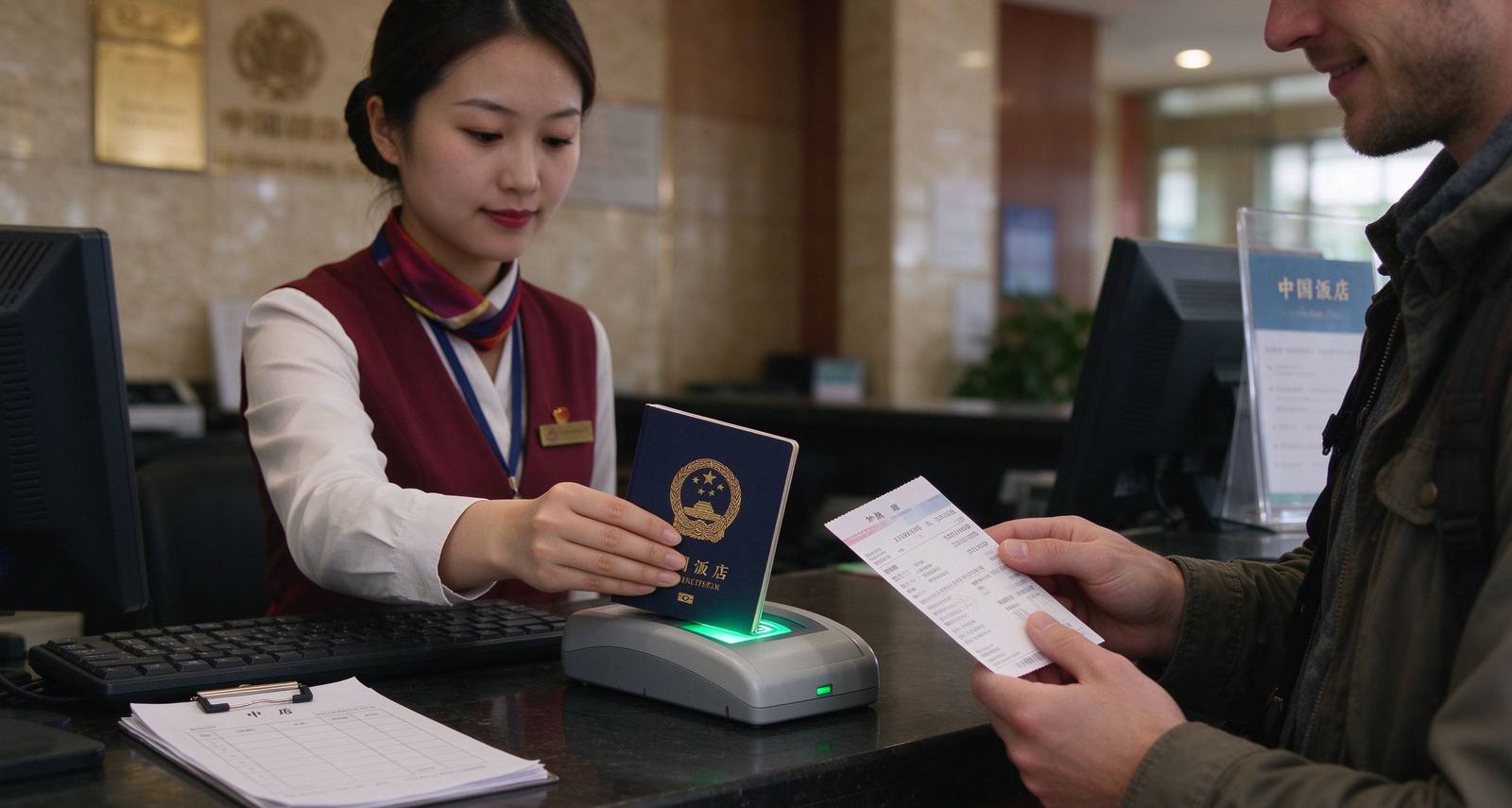 Book this →
What the front desk is actually afraid of
Here is the part that makes the conversation short. The clerk is not refusing you because of your passport. She is refusing you because the property's registration terminal — the machine that talks to the local police system — may not be set up to accept a foreign passport number, and because nobody at a 40-room hotel wants to be the person who left a foreign guest unregistered for two days.
这才是对话真正卡住的地方:她拒绝你,不是因为你的护照,而是因为这店的登记终端(连公安系统的那台)可能没开通外国护照号录入;一家 40 间房的店,没人愿意当那个把外宾漏登两天的人。The fear has a real basis. Under Article 76 of the Exit and Entry Administration Law, failing to register a foreign guest can bring a warning and a fine for the operator. So the safe move for an untrained night clerk is to say no at the door — cheaper than a fine, and no one audits a refusal.
这种怕有依据:《出境入境管理法》第 76 条规定,未按规定登记可对经营者警告并罚款。对一个没受过培训的夜班前台来说,“门口拒掉”是最省事的选择——比罚款便宜,而且拒了也没人查。Once you understand that, the script changes. You are not asking for a favour; you are helping her complete a task she is legally obliged to do anyway. That is why the sentence "my passport, your system, five minutes" works far better than a lecture about government notices.
想明白这一点,话术就变了:你不是在求人通融,而是在帮她完成一件她本来就必须做的登记。所以“护照给你、系统里录一下、五分钟”比讲一通政策文件管用得多。Which hotels will actually say no
Three years of this, plus a lot of reading of Chinese travel forums, gives a fairly reliable pattern. International chains and their domestic equivalents — Hilton, Marriott, IHG, and the Chinese big four of Ctrip-affiliated chains — essentially never refuse: their PMS is configured for foreign documents and their staff are trained on it. Mid-range city hotels in provincial capitals are usually fine. The refusals cluster in small-city budget chains, family-run guesthouses, and converted apartments.
三年经验加上大量看中文旅游论坛,规律相当稳定:国际连锁及其对标品牌基本不会拒(系统本来就支持外国证件、员工也培训过);省会中端酒店通常没问题;真正拒人的集中在小城快捷连锁、家庭民宿、以及住宅改的公寓房。There is also a size effect. A 200-room hotel has a night manager and a registration terminal that has seen a hundred passports. A 20-room guesthouse has one auntie, a WeChat account, and a police officer she calls for everything. She is not going to call him at midnight about your passport.
还有规模效应:200 间房的店有夜班经理、有见过上百本护照的登记终端;20 间房的民宿只有一位阿姨、一个微信、和一位“什么事都问他”的片警。她不会为了你的护照半夜给民警打电话。Note the direction of the incentive, too. A guesthouse that quietly takes you and skips the registration is taking a risk on your behalf and hers. If you later need a registration record — for a visa extension, a hotel-to-hotel dispute, or a police check — there will not be one, and that is your problem, not hers.
也要看清激励方向:民宿悄悄收下你、跳过登记,是替你和她一起冒险。万一你之后需要住宿记录(续签、酒店纠纷、公安核查),记录根本不存在——那是你的麻烦,不是她的。 Book this →
Filter before you book, not at the desk
Chinese booking platforms now carry an explicit reception tag on each property, and it is the single most useful field on the page. One version reads 接待来自任何国家/地区的客人 — accepts guests from any country or region. The other reads 仅接待中国内地签发的有效居民身份证的客人 — mainland ID holders only, which is a polite way of saying no foreigners. Read that line before you read the price.
国内订房平台现在每个房源都带“接待”标签,这是页面上最有用的一栏:一种写“接待来自任何国家/地区的客人”,另一种写“仅接待中国内地签发的有效居民身份证的客人”——后半句就是婉转的“不接外宾”。先看这行,再看价格。On international inventory the signal is weaker, because the English listing is often generated from the Chinese one and drops the tag. My workaround: book the first night in a chain hotel you can verify, and only then experiment with the charming courtyard guesthouse for nights two and three. Arriving at 11pm is not the moment to test a hypothesis.
海外库存的信号更弱,因为英文房源多由中文翻译生成、把标签丢了。我的做法:第一晚订一家可以确认的连锁,等住稳了再拿第二三晚去试那种好看的四合院民宿。晚上十一点落地,不是做实验的时候。If you are booking through an international OTA, the practical test is simpler than the tag: does the property appear in the foreign-language inventory at all, with reviews written by non-Chinese guests? A hotel with three English reviews from last winter is a hotel whose desk has done this before.
如果走海外 OTA,比标签更简单的判断是:这房源在英文库存里有没有、评论里有没有非中文用户?一家去年冬天有三条英文评论的店,前台一定办过这事。At the desk: four sentences that work
First, stay calm and stay literal. Show the booking, show the passport, and say the registration sentence, not the policy sentence. In Chinese: 我需要办理住宿登记,护照在这里 — I need to complete accommodation registration, here is my passport. That frames it as a task, not a complaint.
第一,别急,也别讲大道理。出示订单和护照,说“登记”而不是说“政策”。中文就一句:“我需要办理住宿登记,护照在这里。”这是把话框成一件待办的事,不是一场投诉。Second, offer the system workaround. Many properties can register a foreign guest manually through the police portal even if the ID reader balks; some simply need the passport photo page and the entry stamp photographed and uploaded. Asking 能不能手工录入 — can you enter it manually — has resolved more than half of my cases.
第二,给出系统层面的替代方案。很多店即使读卡器不认,也能在公安端口手工录入;有的只要护照资料页和入境章拍照上传。问一句“能不能手工录入”,我一半以上的情况到这一步就解决了。Third, cite the rule once, gently, and name the source. 商务部等七部门 2024 年发文,不得以无涉外资质拒绝接待境外人员 — the seven-department notice of 2024 says hotels may not refuse on grounds of lacking foreign-related qualification. Say it once. Repeating it turns a clerk into an opponent.
第三,把规定说一遍,温和地,并说出出处:“商务部等七部门 2024 年发文,不得以无涉外资质拒绝接待境外人员。”只说一遍。反复说会把前台变成对手。Fourth, ask for the refusal in writing, or at least ask them to note it in the booking system. 请帮我在订单里备注一下拒绝入住的原因 — please note the reason for refusal on my booking. This costs nothing, and it changes the calculation, because now the refusal is visible to the platform and to the manager.
第四,要求把拒绝写下来,至少让他在订单里备注:“请帮我在订单里备注一下拒绝入住的原因。”这一步不花钱,但会改变对方算账的方式——拒绝变得对平台和店长可见了。 Book this →
If it still ends in a no
Do not spend the night arguing. Take a photo of the desk sign, keep the booking record, and move. In a city of any size there is a chain hotel within fifteen minutes, and a bed at midnight beats being right at midnight.
不要在深夜耗在争论上。拍下前台牌子、留好订单记录,然后走。任何一座有点规模的城市,十五分钟内都有连锁店;午夜一张床,胜过午夜一个“我是对的”。Then report it, the next morning, in writing. Two channels actually work: the 12345 municipal service hotline (there is an English option in most provinces, and a WeChat mini-program version that accepts text), and the National Immigration Administration's 12367 hotline, which handles foreigners' entry-and-stay questions and complaints in English and is the body that co-signed the 2024 notice.
第二天上午,用文字投诉。两条渠道真管用:12345 市政热线(多数省份有英文选项,也有可文字提交的微信小程序);国家移民管理局 12367 热线,专门处理外国人的入出境与停居留问题,中英文都接,而且它就是 2024 年那份文件的联署部门之一。What you should not do is name-and-shame on the spot, or refuse to leave. A clerk who feels cornered calls the police, and the police will side with the registered guest who has a booking — which you do — but the two hours you spend proving it are still gone.
不该做的是当场拍视频开骂,或者赖着不走。被逼到墙角的前台会报警,警察会站在“有订单的住客”一边——也就是你——但那两个小时的举证时间照样没了。One more thing worth knowing: refusal is not evenly distributed by city tier, it is distributed by how recently the property has handled a foreigner. A tourist town that sees Europeans every winter is smooth; a business hotel in an industrial city that sees them never is where the sentence comes out.
还有一点:拒绝不按城市等级分布,而按“这家店上一次接待外国人是什么时候”分布。每年冬天都见欧洲人的旅游城市很顺;工业城市里常年见不到外国人的商务酒店,才会说出那句话。Staying outside a hotel: the 24-hour rule
If you are not in a hotel — a friend's flat, a rented apartment, a rural courtyard house — the registration duty moves to you, and the window is 24 hours from arrival. This is the rule most independent travellers quietly break, and it is the one that causes trouble later, at visa renewal or at a police check.
如果你不住酒店——朋友家、租的公寓、乡下院子——登记义务就转到你身上,时限是入境或入住后 24 小时。这是自助旅行者最容易悄悄违反的一条,也是日后续签或遇检查时出问题的那一条。Since 21 September 2026 this has become much easier. A National Immigration Administration notice (No. 7 of 2026) rolled out online registration nationwide for accommodation other than hotels: through the NIA website, the 12367 app, or the WeChat and Alipay mini-programs. Online registration carries the same legal effect as turning up at a police station window.
2026 年 9 月 21 日起,这件事容易多了。国家移民管理局 2026 年第 7 号公告在全国推广“旅馆以外”住宿的网上登记:移民局官网、12367 App、微信和支付宝小程序都能办,与到派出所窗口办理具有同等效力。Hotel guests do not need to do this. The hotel registers you, and you should receive, or at least be able to ask for, a registration slip — 住宿登记表. Keep it with your passport. It is the document that proves where you slept, and it is the first thing anyone asks for when a stay record is disputed.
住酒店的人不需要自己跑这一趟:酒店替你登记,你应该拿到、至少可以索要一张“住宿登记表”。把它和护照放在一起。这是证明你住在哪儿的凭据,也是住宿记录有争议时第一个被要看的东西。Money, deposits and the small print
The 2024 notice asked hotels to improve foreign-card acceptance and to keep cash on hand, and in practice the gap is closing: big-city hotels take Visa and Mastercard, smaller ones often only take Chinese payment apps. Set up Alipay or WeChat Pay with your foreign card before you arrive — the setup takes ten minutes and saves an hour of desk negotiation.
2024 年那份文件要求酒店改善外卡受理、备足现金;实际差距在缩小:大城市酒店收 Visa/万事达,小城店往往只收国内支付。落地前把支付宝或微信绑好外卡——设置十分钟,能省掉一小时的前台协商。Deposits are normal: 100 to 300 yuan on a budget room, more in a five-star, refunded at checkout after the minibar check. Cash deposits are still common outside major cities, so carry a few hundred yuan in notes even if you plan to pay by phone.
押金是常态:经济房 100–300 元,五星更高,退房查完迷你吧再退。大城市之外现金押金仍常见,所以即便打算手机支付,也带几百元现钞。Every guest gets registered, not just the passport holder who booked. Couples with different nationalities, adult children on the same booking, a friend joining for one night — all of them hand over a passport or ID at the desk. A hotel that waves this away for one of you is a hotel that will wave away the whole registration.
登记是按人头,不是只登记下单的那本护照。不同国籍的伴侣、同一订单里的成年子女、只住一晚的朋友,都要在前台交验证件。哪家店对其中一个人说“算了不用”,这家店对整单登记也会“算了”。 Book this →
The breakfast test, and why it matters
A strange but reliable signal: hotels that serve a proper breakfast buffet with both Chinese and Western options are almost always hotels that have thought about foreign guests, because someone in management already decided to. A property whose only breakfast is a coupon for the noodle shop downstairs has not.
一个古怪但可靠的信号:早餐既做中式又做西式自助的酒店,几乎一定是“想过外国客人”的酒店——管理层有人做过这个决定。早餐只发一张楼下面馆代金券的店,没有。And the reason this matters beyond breakfast: the same management decision that adds a toaster tends to add a registration procedure. The two come from the same person, in the same week, for the same reason.
这不只是早餐问题:决定加一台烤面包机的那双手,往往也决定加一套登记流程。同一个人、同一周、同一个理由。 Book this →
The cheat sheet I keep on my phone
Before booking: read the reception tag, prefer chains for the first night, check whether the property has reviews in a non-Chinese language. At the desk: passport open, booking visible, say 我需要办理住宿登记, offer manual entry, cite the 2024 notice once, ask for the refusal to be noted. If refused: photograph, leave, report to 12345 or 12367 the next morning. Not in a hotel: register online within 24 hours through the NIA channels.
订房前:看“接待”标签、第一晚优选连锁、查有没有非中文评论。前台:护照翻开、订单亮出来、说“我需要办理住宿登记”、提出手工录入、把 2024 年文件说一遍、要求备注拒绝原因。被拒:拍照、走人、次日上午打 12345 或 12367。不住酒店:24 小时内走移民局线上登记。None of this is glamorous. But the difference between a trip where you spend one evening solving a registration problem and a trip where you spend three days wondering whether your stay was ever recorded is entirely in this checklist, and it costs nothing to run it.
这些都不浪漫。但“花一个晚上解决登记问题”和“花三天担心自己到底有没有记录”之间的差别,全在这张清单上,而执行它不花一分钱。One last number that stays with me. On that night in the small city, the chain hotel two streets away took me in at 00:20, scanned the passport, printed a registration slip, and charged 268 yuan for the room. The refusal cost me forty minutes and a taxi. The system, when it works, takes five.
最后一个数字:那晚两条街外的连锁店,00:20 收下我,刷护照、打印登记表,房费 268 元。那次被拒花掉我四十分钟和一趟打车;而系统正常运转时,整个过程五分钟。